Wednesday, March 2, 2022

REVIEW: TRINE OPSAHL - The Moon Stays Bright

TRINE OPSAHL, also featuring JOSEFINE OPSAHL
The Moon Stays Bright
Heart to Heart Records (2021)

Following rather quickly on her critically acclaimed duet album with cellist/daughter Josefine Opsahl (The Infinite between Us), Celtic harpist Trine Opsahl has released what I consider to be her most serene, meditative, and comforting album to date – The Moon Stays Bright. Josefine does appear on a few tracks, including alternative versions of solo harp tracks from this same album. Those "alt" takes are substantially different so don't make the mistake of thinking some songs are "duplicates" since they are not.

I've been a huge fan of Trine's Celtic harp recordings since I heard her second solo release, 2012's Somewhere in a Hidden Memory (I later heard her actual second recording which was her first duet release with Josefine, Leaving My Silent Empty House). Admittedly, I love Celtic harp music, but when that instrument is in the hands of such a skilled, talented, and soulful artist as Trine, well, it's just magic, pure and simple. 

Besides being a recording artist, Trine is also a Certified Therapeutic Harp Practitioner and performs throughout Denmark, playing for terminally ill patients and their families to ease the emotional (and physical) pain of the patients' passing. This level of musical empathy, so to speak, is present on all her albums, but on The Moon Stays Bright, it glows the brightest I have heard so far. The sensation of calm, serenity, healing energy yet peaceful resignation are palpable from the first note to the last. I can't imagine an album more suffused with these qualities and, obviously, this would be an excellent choice for everything from massage to meditation to, well, funeral services, to be honest.

As mentioned in the opening paragraph, daughter and renowned cellist Josefine Opsahl joins Trine on three tracks which are reworked version of three solo pieces from the album and the other nine songs are all solo harp pieces. Of note, three of the solo pieces are wholly improvised, those being "Moonscapes I" and "II" and "III." These three songs carry an undertone of ethereal wonder, and I imagine watching the moon drift among broken clouds with these as a soundtrack would be a special time indeed. Some of the other songs carry subtle Celtic influences, discernible if one listens for it.

The three tracks which are duets display Josefine's stellar cello artistry but in a more subdued style than some of her previous collaborations with her mother. As I have stated in each of the efforts as a duo, Josefine and Trine play as if of one mind, one soul, and one heart.

I dislike ranking albums from artists whom I consider to always be at their best on every recording, so I can't state that The Moon Stays Bight is Trine Opsahl's best release (because it would be like a parent picking a favorite child), but it is her most serene and soothing work, at least to my ears. I could listen to this for hours and never tire of its ability to erase my cares and worries.

CREDITS:

All music composed by Trine Opsahl
Cello arrangements by Josefine Opsahl
Produced by Thomas Vang
Mastered by David Elberling
Recorded at The Village Recording Studio, Vanløse, Denmark
Cover photo by RihnPhoto
Cover design by Nina Krogh

REVIEW: KEVIN KELLER - Shimmer


KEVIN KELLER
Shimmer
Kevin Keller Music (2021)

By now, when I am reviewing certain artists who have shown they are masters of multiple styles of music, I shouldn't be caught that much by surprise, but I must admit that even knowing how talented pianist/keyboardist Kevin Keller can be, Shimmer blew me away. Shimmer is a brilliant mélange of Berlin-school, ambient, and minimal piano soundscapes, that also does what only fantastic albums do, i.e. its relatively short playing time left me craving "More, please, sir" (a favorite phrase of my wife, Kathryn, when she wants more of something).

I've been a huge admirer of Keller's work since reviewing his album, Santiago's Dream, in 2006. I consider his "triptych" of melancholic chamber pieces: 2009's in absentia, 2012's the day I met myself, and 2013's nocturnes, to be a singular masterpiece, after a fashion, as if all  sprung forth from the same artistic wellspring of emotion.

Keller has certainly ventured into electronic music before, including his most recent release, the brilliant The Front Porch of Heaven (which I criminally admit to never having found the time to review). On Shimmer, you will hear some superb slices of Berlin-school EM, such as the opening rapid sequencer work on "Orchards" and the truly epic "Riverbend,' (a wonderful 8+ minutes and which, to my ears, equals anything from the heyday of the Groove Unltd label). However, Keller doesn't dip his toes into just that Germanic style of music. The title track is a voyage into somber piano refrains framed by haunting wordless female vocals which, to me, could almost be used as part of the soundtrack to the film Annihilation, (although I admit that part of my association to that film is not just the beautiful moodiness of the music, but also that the film centers around a mysterious area called "the shimmer"). "Ithaca" is ambient bliss, a series of drifting soundscapes played against a background of faint piano melodies. The layered electronics on "Bridges" have a pleasing retro sound to them and interlock perfectly with some of Keller's best piano work on the album, as the latter paints in midtempo but introspective and shadowy colors. The album closes with "Delta" which echoes some of the music from his triptych mentioned above as it's closer to a chamber music aesthetic, with the surprising (to me, at least to me) inclusion of some Fender Telecaster played by Keller. Keller's guitar playing mirrors some of Robin Guthrie's (Cocteau Twins)* sonic qualities but not in any manner of imitation, merely as how it sounds within this context.

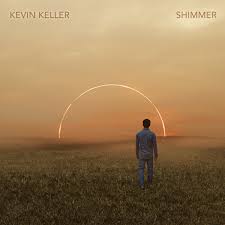
Two things outside of the brilliant music are worth mentioning. One is the jaw-droppingly beautiful and evocative cover which, again, I believe elicits comparison to Annihilation, even if the association may seem forced to some of you readers. The second thing that struck me is the cryptic but fascinating track titles which I find fascinating. I am not one hundred percent opposed to song titles that either convey the song's main idea or that indicate the particular mood of the music itself. However, being a longtime fan of Tim Story's likewise pleasingly obscure titles (especially on his album, Beguiled), I've always appreciated artists who think outside the box when it come to "naming" their work with something other than one of the standard formulas.

With Kevin Keller, one never knows what will spring forth from his muse, but I am always confident I will enjoy it and even marvel at his imagination, talent, and versatility.

CREDITS
Music composed by Kevin Keller, except "Delta" composed by Kevin Keller and Rayne Kristine
Produced by Kevin Keller
Mastered by Chris Frasco in Nashville, TN
Cover photo by Gremlin

 *Thanks to the artist for this. Kevin let me know that that Guthrie was a direct inspiration.

REVIEW: MYCHAEL DANNA AND TIM CLEMENT - North of Niagara (Remastered)


MYCHAEL DANNA AND TIM CLÉMENT
North of Niagara
Summerland Music (2021)

While remastering and remixing an album usually brings some measure of improvement from an album's initial release, I am sometimes skeptical about the degree of change such a process yields. Which is why, when I played the remastered/remixed North of Niagara (the 1995 masterpiece from Mychael Danna and Tim Clément) I nearly stopped in my tracks, literally. My first listening was done while driving and I almost did stop and pull over to the side of the road. I simply couldn't believe the exponential improvement - well, the word improvement is a vast understatement – that I was hearing. It was like listening to this amazing album for the first time! And that first time, back when it was first released, blew me away then. So, you can well imagine just how amazing this "updated" version sounds. Of course, it helps that the music itself is beautiful beyond my ability to put into words.

North of Niagara is part of a trilogy of albums that Danna and Clément recorded which were inspired by the landscapes of northern and central Ontario. Per the new liner notes, the two dubbed the musical style as "Canadian environmental music." North of Niagara was the conclusion of the trilogy and what a finale it is!

The twelve tracks vary in tone and mood but seldom stray from an overall sensation of reflection and contemplation. However, under that umbrella classification the listener is treated to the warm, pastorale reverbed piano of the opening "Cootes Paradise," the lush, sweeping washes of synthesizer on "Ravensview," the gold-tinted nostalgia of "Remember Summer," featuring Gene Goral's subtly bluesy accordion (yes, accordion on an ambient album!), and the wistful yet melancholic "Old Mail Road," with a guest appearance by Eric Hall on bassoon. And that is just the first four tracks! Next, "Mount Nemo" brings drama to the forefront via escalating synthesizer chords, which gain passion and volume, counterpointed, at the outset, by plaintive piano. Back in 1995, I was not as fond of this track due to the change in mood compared to the rest of the album. However, time has altered my opinion, mostly because the music does capture the feeling (musically speaking) of viewing and climbing the titular mountain.

This is a good time to point out that the inspiration for North of Niagara is the Bruce Trail which (and this is from the liner notes) "… begins at Niagara Falls and follows the Niagara Escarpment, the edge of an ancient shallow sea, for 880 kilometers northward to Tobermary." The trail is also Canada's oldest and longest footpath. Every song is named for an actual location along the trail and the liner notes display a map of the Bruce Trail, noting each location. Besides the tracks already mentioned, others include "Silent Lake," "Crooks Hollow," and "Crawford Lake." Woven throughout the album (not necessarily on every song) are some discretely used and well-recorded field recordings of nature (recorded by the artists), such as birdsong, lapping waves, and more. Regardless of how you may feel about embedded nature sounds on instrumental recordings, the inclusion of them here not only "belongs" from a thematic standpoint, but enhances the music, elevating it to a unique and transportive listening experience.

Besides Danna and Clément's shared duties on piano, synthesizer, guitars, and treatments, the album also features the artists mentioned earlier as well as Kim Deschamps (pedal steel guitar) and Paul Intson (bass guitar). Where each guest artist appears, their contributions are masterfully executed. One more thing to note is that initial release in 1995 (on Hearts of Space) featured digital piano. For this re-release, the piano tracks were re-recorded, this time on a 1983 Steinway B, making that instrument's warmth much more apparent.

Because I love this album so much, I will describe a few more of the songs. "Silent Lake" conveys its pastorale beauty via reverbed bell tones set against a background of crickets and birdsong, evoking resting beside the lake itself, perhaps as the sun sets. This is one of the softest tracks, floating in nature, and perfect to melt into. "Crook's Hollow" has a reverbed piano refrain that is more pleasantly reflective than it is somber/melancholic, with an assortment of ambient textures coalescing around the lead semi-minimal melody line. "Headwater Trail" is one of the more "pure" ambient songs as layers of synthesizers flow over a low-pitched rumbling texture and birdsong (loons?) deep in the mix, discernible but subdued. The closing "Lookout Point," is a lonely sounding track, with a sparse reverbed piano refrain that slowly evolves but never strays from the evocation of somberness as it winds down at the end.

If you already own the 1995 original, you should still buy this because it's such a stunning revelation of what remastering/remixing can do to an album. If you don't own the original…well, what are you waiting for? North of Niagara is one of the most haunting and evocative albums in the genre of piano/synthesizer ambience. 

CREDITS:

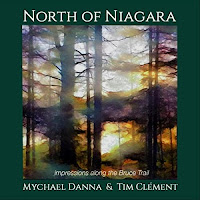
Artwork, photography, and album design: Tim Clément
Bruce Trail map: Ben Watson
Consultants; Ron Korb and Dylan Gauthier
Mastered by Steve Marsh

All music by Mychael Danna and Tim Clément